
Strengthening access to justice: Annual Report 2022
Table of contents
Section 1: Land acknowledgement
The Canadian Human Rights Tribunal conducts hearings and mediations across Canada on traditional territories of Indigenous Peoples. We prepared this report in Ottawa, the traditional unceded and unsurrendered land of the Algonquin Anishinabeg People.
We all have a role to play in the process of reconciliation. We invite you to learn more about the people whose traditional lands you are on.
Section 2: Who we are and what we do
The Canadian Human Rights Tribunal (the “Tribunal”) is an administrative tribunal. We work hard to be less formal than a court. We are independent and work at arm’s length from the federal government. This means that no Minister or other government official can tell us how to decide our cases. We are accountable to Canadians and report on our activity to Parliament through the Minister of Justice.
Under the Canadian Human Rights Act (CHRA), the Tribunal hears cases of discrimination involving federally regulated organizations like the military, airlines, interprovincial trucking, banks and the federal public service. Tribunal members are decision-makers. They hear complaints of discrimination that have been referred to us by the Canadian Human Rights Commission (the “Commission”). Tribunal members review submissions and evidence, listen to witnesses and, in the end, decide whether discrimination has occurred. If it determines that discrimination occurred, the Tribunal can rule on remedies. Parties can decide to settle their complaints through mediation or proceed to a hearing.
“We are accountable to Canadians and report on our activity to Parliament through the Minister of Justice.”
The Tribunal also has two other mandates. The first is under the Pay Equity Act (PEA), which requires employers to take a proactive approach to giving men and women equal pay for doing work of equal value. We have two roles under the PEA:
- the Pay Equity Commissioner can refer an important question of law or jurisdiction to the Tribunal to determine; and
- an employer, bargaining agent (e.g., union) or other affected person may appeal some of the Pay Equity Commissioner’s decisions or orders to the Tribunal.
We are also preparing to be able to make decisions under the Accessible Canada Act (ACA), which aims to ensure that everyone in Canada can fully participate in society by requiring federal organizations to proactively identify, remove and prevent barriers to accessibility for persons with disabilities. Our role under the ACA is to decide appeals of certain decisions made by the Accessibility Commissioner.
As of December 31, 2022, the Tribunal consists of a Chairperson, a Vice-Chairperson and three full-time members. Eight part-time members work from various places across the country.
We continue to work on becoming a more accessible tribunal and will continue our initiatives that support justice as a service.
Section 3: Message from the Chairperson
On behalf of the Tribunal, I am pleased to present our 2022 Annual Report. It was an honour to be appointed Chairperson of the Tribunal this year. I am also pleased to share that Athanasios Hadjis was appointed Vice-Chairperson in 2022. I am very grateful for the support of the Tribunal members who resolve cases and the secretariat staff that make the Tribunal’s work possible.
We are privileged to do this work because the Tribunal’s mandate is important. The work we do protects the rights of all Canadians to equality, equal opportunity, fair treatment and an environment free of discrimination. The resolution of disputes under the CHRA, the PEA and, going forward, the ACA, matters deeply to the people involved. These cases can also have significant public interest ramifications.
I am concerned with how long it takes to resolve cases because of the impact delay has on the parties. This challenge isn’t unique to the Tribunal. Concerns about the timeliness of processes in administrative justice have gained media attention over the years. It’s a problem we need to fix. Our processes are slow and hard to understand, particularly for those who navigate the system on their own without the support of a lawyer. While we started making modest changes in 2022, we have much to do to improve how we serve the public.
This year, we conducted most of our hearings and mediations by videoconference. Our experience over the last three years shows that videoconferencing is effective because it allows us to schedule cases more quickly and saves time and money for the parties. We’ll continue to offer it as an option where it makes sense for the parties, in addition to resuming in-person hearings and mediations.
It is important for us to be transparent with the public. In 2022, the Tribunal began to develop a backlog of cases. Parties can expect to wait six months or more before their file is assigned to a member for case management if the parties do not agree to mediate or the complaint is not settled. Waiting this long is not acceptable, but we will continue to experience delays in case management and hearings for two reasons.
First, we need additional capacity. We are working hard to address this with new members and adjudicators. The Tribunal also needs sustainable and efficient operations to support its work. I have asked the Administrative Tribunals Support Service of Canada (ATSSC), which provides all staff and facilities service support to the Tribunal, to address this issue so that the Tribunal is in a far stronger position to respond to the parties’ needs and to deliver effective and timely service.
“Starting in 2020, the number of complaints received at the Tribunal has increased by more than 70% compared to the preceding three-year period.”
“Our priority will continue to be to make our processes faster and easier to use.”
Second, we continue to see an increase in the number of cases we receive at the Tribunal because the Commission is moving through its caseload more quickly. Starting in 2020, the number of complaints received at the Tribunal has increased by more than 70% compared to the preceding three-year period.
Starting last year, we took steps to start to address the delays in other ways.
- We trained our adjudicators to write more concise reasons so that parties wait less time to get their decision.
- We started a pilot project working with a roster of experienced human rights mediators. This has allowed us to schedule mediations quickly, often at short notice. This also frees up our members, so they have more time to devote to case management and hearings. The feedback we received from the parties on this pilot is positive. I have asked the ATSSC to continue to support this initiative, which saves the parties and the Tribunal considerable time and resources as complaints are resolved.
- We are working on a comprehensive case management strategy. This will allow simpler complaints to proceed more expeditiously while others, involving wide-ranging systemic allegations, may require greater resources to advance. The Tribunal must manage and adjudicate complaints in a proportionate way. I will seek the support of the ATSSC to develop training materials for members. I will also look for their assistance in implementing an effective case management strategy and related guidelines in the coming year.
While the speed of proceedings matters, so does the quality of how we adjudicate. For this reason, members were trained on trauma-informed processes, ensuring respectful and inclusive hearings, and explored how to mitigate the dangers of implicit bias. We will continue to focus on ensuring the quality of our decisions and adjudication skills and practices.
Our priority will continue to be to make our processes faster and easier to use. But significant shifts will not happen within the current structure given the pressures placed on staff and members alike. I look forward to working with the ATSSC so that the Tribunal can deliver on its mandate and provide fair and timely recourse to Canadians.
Jennifer Khurana
Chairperson
Canadian Human Rights Tribunal
Section 4: 2022 in numbers
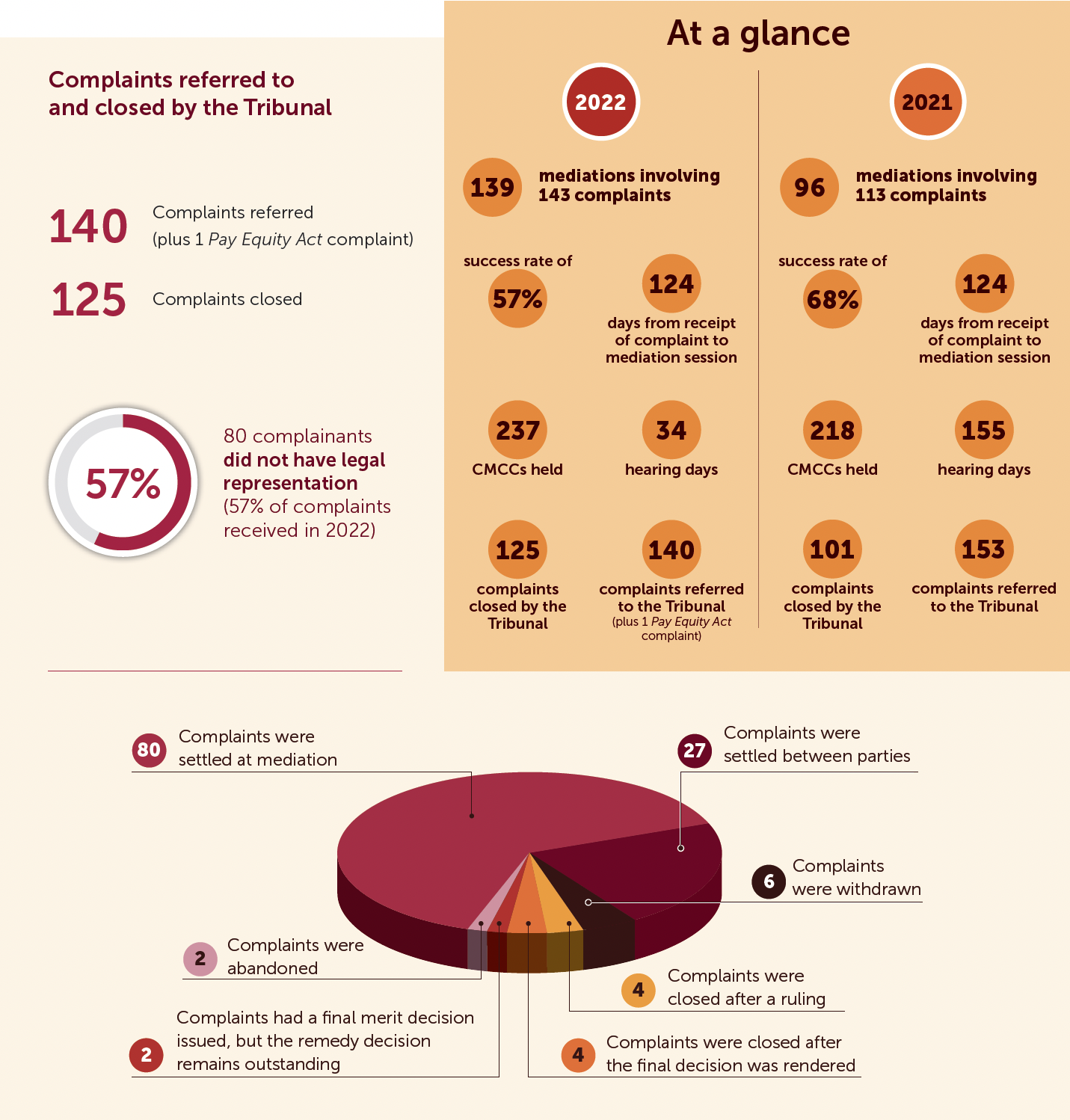
2022 in Numbers
2022 In Numbers
Complaints referred to and closed by the Tribunal:
- 140 complaints referred to the Tribunal under the Canadian Human Rights Act (plus 1 Pay Equity Act complaint).
- 125 complaints closed by the Tribunal.
- 57% of complainants did not have legal representation.
At a glance
2022:
- 139 mediations involving 143 complaints. Success rate of 57%.
- 124 days from receipt of complaint to mediation session.
- 237 case management conference calls held.
- 34 hearing days.
- 125 complaints closed by the Tribunal.
- 140 complaints referred to the Tribunal (plus 1 Pay Equity Act complaint).
2021:
- 96 mediations involving 113 complaints. Success rate of 68%.
- 124 days from receipt of complaint to mediation session.
- 218 case management conference calls held.
- 155 hearing days.
- 101 complaints closed by the Tribunal.
- 153 complaints referred to the Tribunal.
The pie chart shows a breakdown of complaints for 2022. The chart has seven segments, labelled as follows (clockwise from the top):
- Complaints settled at mediation: 80
- Complaints settled between parties: 27
- Complaints withdrawn: 6
- Complaints closed after a ruling: 4
- Complaints closed after final decision rendered: 4
- Complaints had final merit decision issued, but remedy decision remains outstanding: 2
- Complaints abandoned: 2
Adjudication
Cases that are not resolved at mediation and continue through the process are assigned to a member to case manage the file. The Tribunal actively manages complaints in case management to move them through the adjudicative process.
Complex or high-conflict cases may require ongoing case management by members, who typically conduct multiple case management conference calls (CMCCs). CMCCs are designed to address issues like the sharing of documents, identifying witness lists, and joining and amending complaints. Tribunal members can also work with parties to narrow the issues in dispute, explore options for mediation and reduce the time needed for a hearing.
In 2022, Tribunal members issued 38 rulings which were published. Rulings usually address a procedural issue that parties need to resolve before a hearing can take place. The Tribunal also issues directions to parties as they move through the steps of the process.
In contrast to a ruling, a decision is when a Tribunal member issues written reasons that decide the core issues in the case. A decision usually sets out whether discrimination occurred and, if so, determines what remedy should be ordered because of the discrimination. The Tribunal issued six final decisions in 2022.
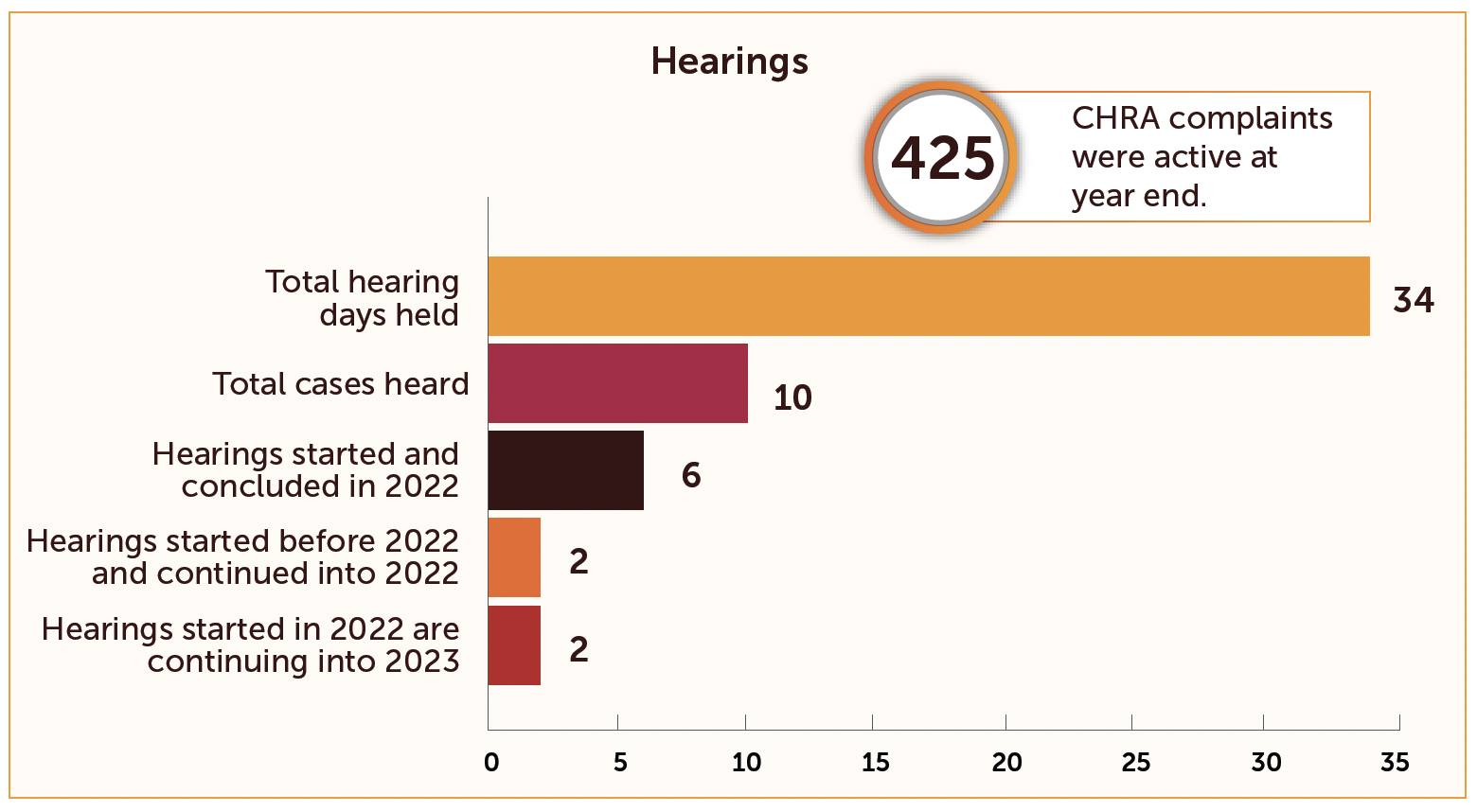
Hearings
425 CHRA cases active at year end.
The title of this horizontal bar chart is “Hearings”.
The chart has five horizontal data bars:
- Total hearing days held: 34
- Total cases heard: 10
- Hearings that started and concluded in 2022: 6
- Hearings that started in 2022 and continued into 2022: 2
- Hearings continuing into 2023: 2
The scale on the horizontal axis of this chart is labelled from 0 to 35, in increments of 5.
Referrals from the Canadian Human Rights Commission
In 2021, the Commission modernized its approach to screening and referring complaints to the Tribunal. Under this new process, the Commission aims to send complaints to the Tribunal more quickly. When the Commission refers complaints earlier in its process, it relies on subsection 49(1) of the CHRA.
We are monitoring how these new subsection 49(1) complaints progress at the Tribunal. These complaints are already a significant portion of the complaints we receive—63 of the 140 complaints (45%) received in 2022.
- Out of 140 CHRA complaints, the Commission fully participated in 48 complaints. 34.3%
- The Commission elected to not participate in 30 complaints. 21.4%
- The Commission partially participated in the remainder of the 62 complaints. 44.3%
New complaints by categories of discrimination 2022
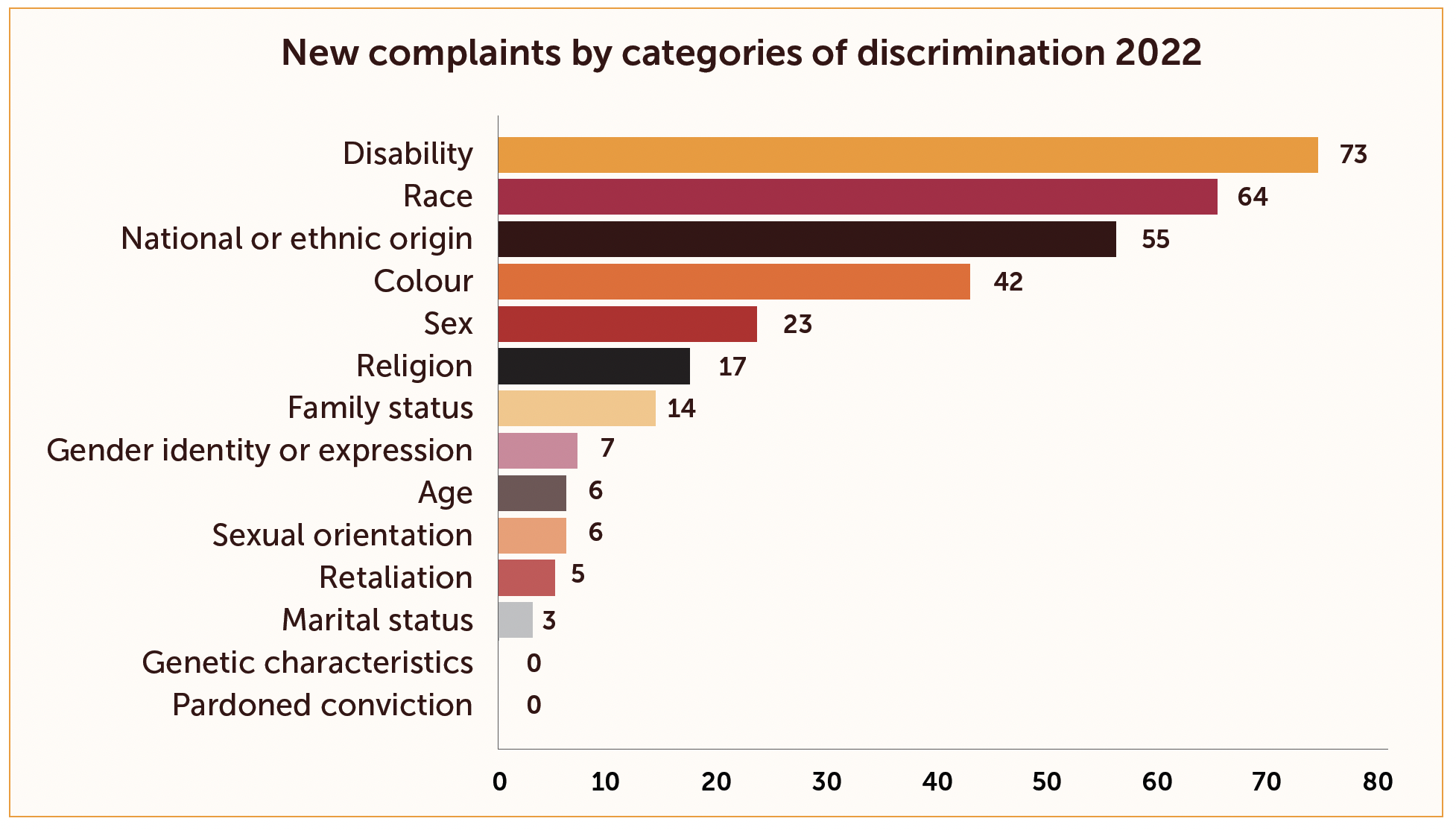
New complaints by categories of discrimination 2022
Horizontal bar chart showing the number of new complaints received by the Tribunal in 2022.
There are 14 individual horizontal data bars showing the number of new complaints received in 2022. Each data bar corresponds to a prohibited ground of discrimination as set out in the Canadian Human Rights Act. The length of each horizontal bar is proportional to the number of new complaints. The scale of the horizontal axis goes from 0 to 80, in increments of 10.
New complaints by categories of discrimination in 2022:
- Disability: 73
- Race: 64
- National or ethnic origin: 55
- Colour: 42
- Sex: 23
- Religion: 17
- Family status: 14
- Gender or identity expression: 7
- Age: 6
- Sexual orientation: 6
- Retaliation: 5
- Religion: 23
- Marital status: 3
- Sexual orientation: 1
- Genetic characteristics: 0
- Pardoned conviction: 0
Representation
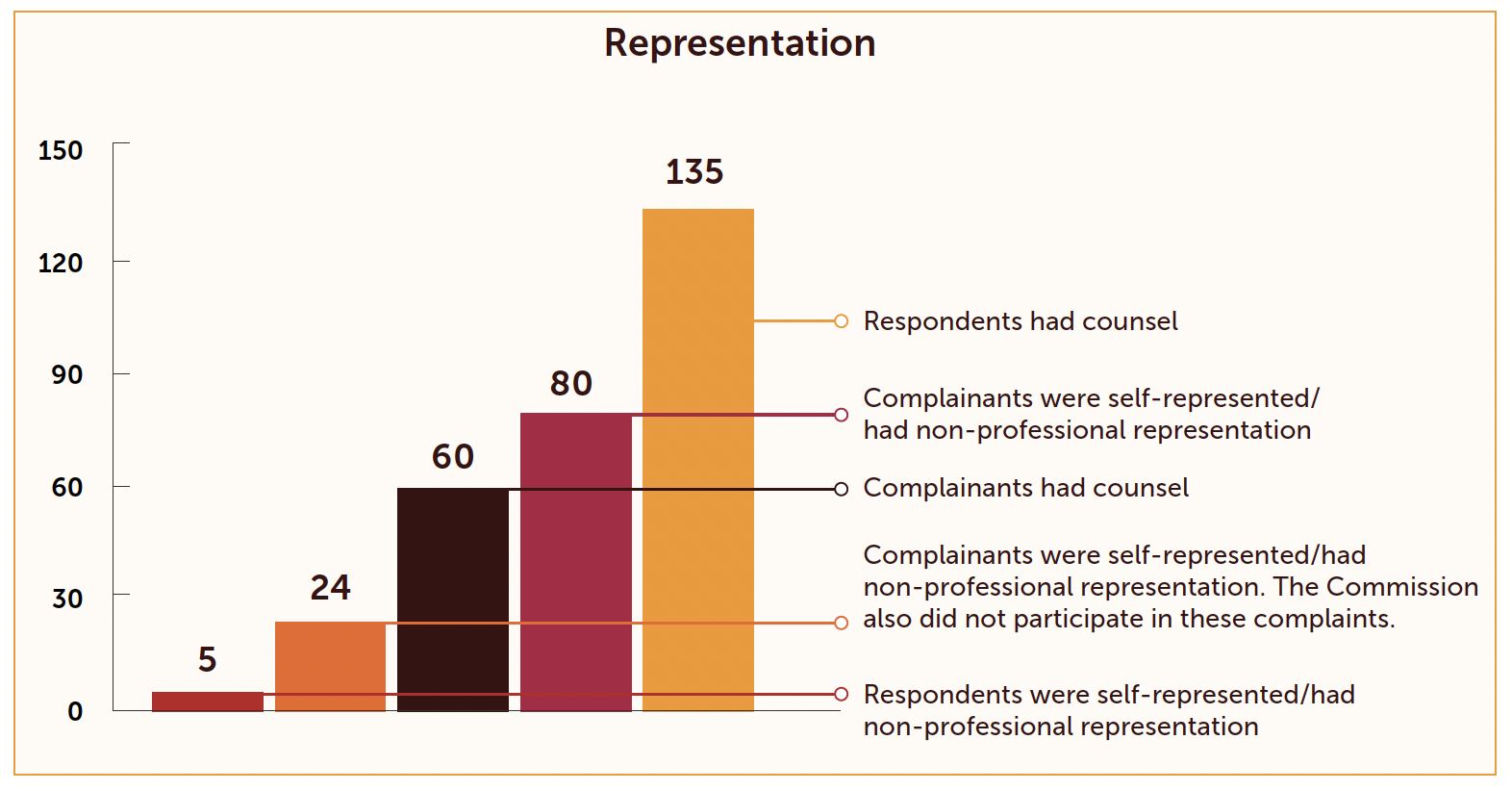
Representation
Vertical bar chart titled "Representation", showing data on new complaints to the Tribunal in 2022 according to their type of legal representation.
There are five individual vertical data bars, one for each type of representation. The scale of the vertical axis goes from 0 at the bottom to 150 at the top, in increments of 30. The height of each of the five bars is proportional to the number of complaints for that category of legal representation.
Going from left to right, the bars illustrate the following:
- 5, the number of complaints where the respondent was self-represented or represented by someone other than a professional legal counsel;
- 24, the number of complaints Complainants were self-represented/had non-professional representation and in which the Commission was not participating;
- 60, the number of complaints where the complainant had counsel;
- 80, the number of complainants who were self-represented/had non professional representation;
- 135, the number of complaints where the respondent was represented by counsel.
Types of respondents
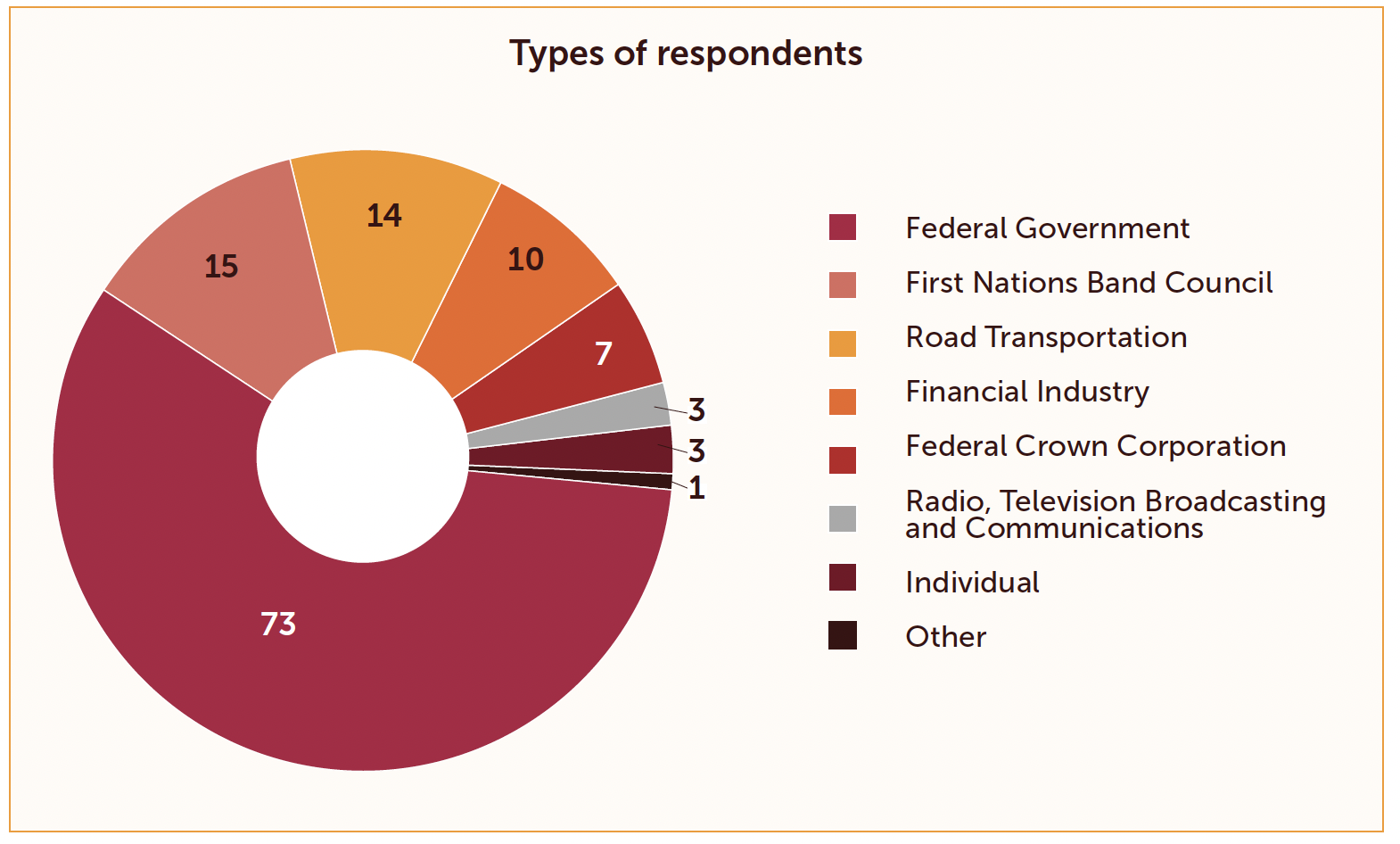
Types of respondents
This pie chart is titled "Types of Respondents". It presents data on new complaints to the Tribunal in 2022 according to the type of respondent involved in each complaint.
There are eight segments in this pie chart, one for each respondent type. Each respondent type segment has a number next to it for how many new complaints the Tribunal received in 2022 for that segment.
From the largest segment to the smallest in a clockwise order, the pie chart illustrates the following:
- Federal government: 73
- First Nations band council: 15
- Road transportation: 14
- Financial industry: 10
- Federal Crown corporation: 7
- Radio, television broadcasting and telecommunications: 3
- Individual: 3
- Other: 1
Section 5: Mediation
Mediation is a voluntary and confidential option for parties who want to try to resolve their complaint before it goes to a hearing. The parties work with a Tribunal mediator to settle the complaint. If no agreement is reached, there is a hearing.
Settling a complaint in mediation is faster than going to a hearing. The parties control the process and can decide the outcome. Mediation can also save the parties a lot of time and money, including in legal fees.
Some complaints are highly complex and include allegations of systemic discrimination. Even if mediation does not settle the entire complaint, it can help reduce the number of issues in dispute. This means the parties can move through case management and to a hearing more quickly. The Tribunal can appoint a mediator early on in the process or can work with the parties as the case moves forward in case management to try to facilitate settlement at any stage.
In 2021, the Tribunal adopted a new, more streamlined approach to mediation. All parties are offered the opportunity to try mediation before proceeding to case management. In the fall of 2022, we started working with a roster of experienced human rights mediators and former adjudicators. These mediators can provide valuable insight to the parties and can help them consider options since they have all been human rights adjudicators themselves. This has also allowed the members to focus on case management and hearings and helped to mitigate delays.
The streamlined mediation process and roster of mediators are showing positive results. We hope to continue working with these mediators to provide timely mediation service to the parties we serve.
“Mediation can also save the parties a lot of time and money, including in legal fees.”
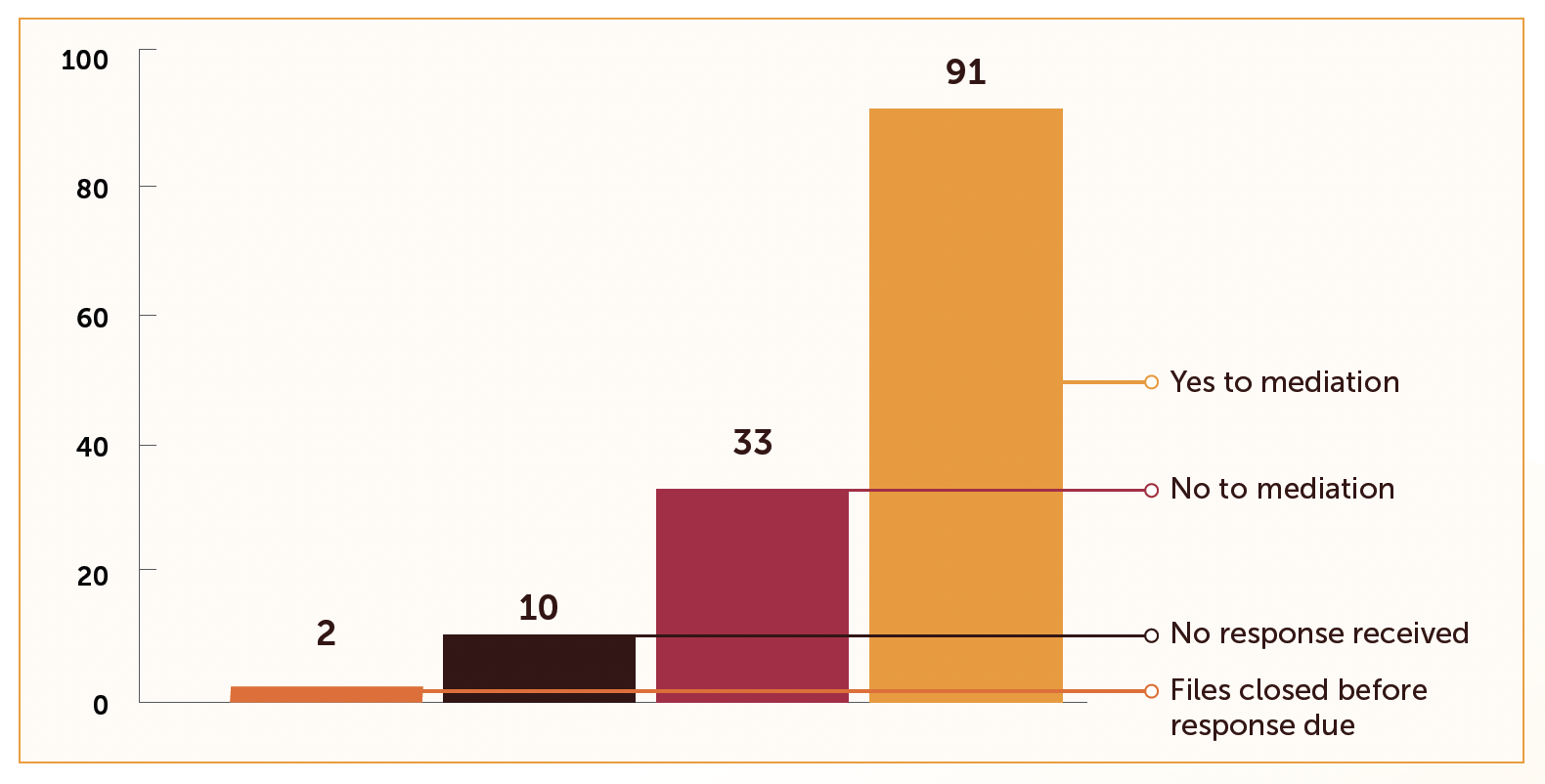
Mediation
Vertical bar chart shows responses for mediation in 2022.
There are four segments in this vertical chart, one for each mediation situation. The scale of the vertical axis goes from 0 at the bottom to 100 at the top, in increments of 20. The height of each of the four bars is proportional to the number of complaints for mediation.
Going from left to right, the chart illustrates the following:
- 2, the number of files closed before response due
- 10, no response received
- 33, no to mediation
- 91, yes to mediation
In 2022, all mediations were held by videoconference, except for one that was held in person. In 2022, parties
agreed to mediation at the outset in 91 cases. On average it took us four months from the receipt of a complaint
until a mediation was held.
Mediation results
In 2022, 139 mediations were held involving 143 complaints. Of these, 82 complaints were settled, and the
files were closed. Another two complaints were settled for which the Commission’s approval of the minutes
is outstanding as of December 31, 2022. Taking these cases into account results in 84 cases settled during
mediation in 2022 for a success rate of 59%. Some files settle later in the process, and this investment in
alternative dispute resolution is paying dividends.
Section 6: Rules of procedure under the Pay Equity Act
This year the Tribunal carried out a consultation with stakeholders in the federal pay equity sphere to seek feedback on draft rules of procedure and forms for use in appeals and inquiries into referrals under the PEA.
The Tribunal carefully considered the invaluable feedback provided by stakeholders. In many cases, the Tribunal updated the draft rules in response to the feedback received. The Tribunal sincerely appreciates the time stakeholders took to assist it.
The updated Rules Respecting Pay Equity provide parties with a clear understanding of the PEA referral and appeal processes before the Tribunal and everyone’s roles and responsibilities within those processes. It is our hope that these new draft rules enable procedures that are as informal and quick as the requirements of natural justice allow.
The Tribunal will use the Rules Respecting Pay Equity to guide its procedures on an interim basis. The Tribunal will monitor their success before it begins the formal process of publication in the Canada Gazette, Part I. The Tribunal has one inquiry into a pay equity referral underway and no appeals of a decision or order from the Commission have been received since the PEA came into force on August 31, 2021.
“The Tribunal sincerely appreciates the time stakeholders took to assist it.”
Section 7: Summaries of some 2022 decisions
The following cases are examples of the variety of matters and complexity of issues our Tribunal members
decide. The Tribunal’s decisions are published on our website.
Dominique (on behalf of the members of the Pekuakamiulnuatsh First Nation) v. Public Safety Canada, 2022 CHRT 4
In this case, the Tribunal decided that the First Nations Policing Program discriminated against Gilbert Dominique, a representative of the Pekuakamiulnuatsh First Nation, and members of the Mashteuiatsh community. This program, implemented and financed in part by the federal government, enables First Nations to have an Indigenous police service.
The Tribunal decided race was a factor in adverse treatment related to the First Nations Policing Program. The funding received from the federal and provincial governments does not allow the Mashteuiatsh police to provide police services that are on par with non-First Nations police forces. The only way for the First Nation to provide its community with services comparable to those offered to the neighbouring municipalities, and to other citizens of Quebec, would be to use the services of the Sûreté du Québec. However, the evidence showed that the Sûreté du Québec cannot offer services adapted to the particular needs of the First Nation. Therefore, the Pekuakamiulnuatsh are at a disadvantage because they need to choose between the underfunded Mashteuiatsh police services and the Sûreté du Québec’s services which are not adapted to the particular needs of the community. Since they are members of First Nations, the Pekuakamiulnuatsh are the only ones who have to make this choice and, as a result, are denied equal opportunity compared to other communities.
The community of Mashteuiatsh set up a self-administered First Nations police service adapted to its needs. The evidence showed that the Mashteuiatsh First Nation police service is chronically underfunded: the funding does not allow the First Nation to offer its members a basic police service comparable to that enjoyed by neighbouring communities. When the First Nation attempts to do so, it runs a deficit year after year.
The Tribunal examined the First Nations Policing Program in the historical and current context of First Nations policing on reserves in Quebec. The Tribunal also emphasized that it must take judicial notice of certain facts, including systemic discrimination and racism against members of First Nations and known conflicts between the police and this visible minority.
The Tribunal determined that Public Safety Canada’s funding provided under the First Nations Police Program is a service. Once the federal government provides benefits such as the First Nations Policing Program, it is obliged to do so in a non-discriminatory manner.
The Tribunal found that the implementation of the First Nations Policing Program perpetuates existing discrimination and that the goal of substantive equality is not being and cannot be achieved through the program because of its very structure, which necessarily results in a denial of service. The Tribunal will hear submissions from the parties on the issue of remedies at a later date.
There is a judicial review of this decision in the Federal Court (Federal Court file T-454-22).
Bird v. Paul First Nation, 2022 CHRT 17
This case involves a conflict between Stacey Bird’s teaching job and her obligations as a mother caring for her youngest daughter.
Ms. Bird is a member of the Paul First Nation. She was a teacher at the Paul First Nation School. Ms. Bird relied on her mother to care for her almost two-year old daughter while she was teaching at the school.
At the end of September, her mother was admitted to the hospital. Ms. Bird asked the school for five weeks off work to look after her young daughter. The school told her that she needed to provide five weeks of lesson plans before her leave would be approved. Ms. Bird would not be able to prepare this over the weekend before starting her leave. She withdrew her leave request and decided to find other childcare options instead.
Ms. Bird found a last-minute babysitter. The babysitter ended up having to attend a funeral later on the same day that she was caring for Ms. Bird’s daughter. The babysitter asked to drop off Ms. Bird’s daughter. Ms. Bird found her childcare situation stressful. Ms. Bird was allowed to leave work to get her daughter. On her way, she stopped to speak to the Director of Education, who had required the five weeks of lesson plans before approving her leave request. Ms. Bird was very upset during this conversation and impulsively quit. Ms. Bird also had a conversation with her principal. Again, Ms. Bird was upset and told the principal that she was quitting. Ms. Bird did not return to work.
The Tribunal found that the requirement to provide five weeks of lesson plans before taking a leave of absence discriminated against Ms. Bird. This was discrimination based on family status because the requirement to provide the lesson plans interfered with Ms. Bird’s ability to care for her youngest daughter. The Tribunal awarded Ms. Bird $6,500 for pain and suffering because of this discrimination.
The Tribunal did not agree that Ms. Bird’s job ended because of discrimination. Ms. Bird quit. She was not forced to quit. As Ms. Bird quit, the Paul First Nation did not end Ms. Bird’s employment. Therefore, it was not discrimination when Ms. Bird quit her teaching job.
Luckman v. Bell Canada, 2022 CHRT 18
Bell Canada discriminated against Glenn Luckman because of his disability when it fired him.
Mr. Luckman worked for Bell Canada as a business development manager. His job was to sell Bell Canada services to large clients like school boards.
Mr. Luckman cared for his father. Mr. Luckman’s father eventually passed away. Mr. Luckman took some time off to be with his father in his final days and to mourn his father’s death. At about the same time, Mr. Luckman was diagnosed with cancer. He took a sick leave to get treatment and recover. He was off work for several months.
Mr. Luckman had difficulty returning to work. He did not have a lot of support from Bell Canada. His first try to return to work after his sick leave was unsuccessful. He needed a second short leave of absence. Mr. Luckman was fired very soon after he returned to work for the second time. Bell Canada did a round of layoffs at this point, but Mr. Luckman was the only one from his team who was laid off.
Bell Canada said that Mr. Luckman was fired because of poor performance. The Tribunal did not agree that Mr. Luckman was performing worse than his coworkers. The Tribunal did not accept this explanation.
One of Mr. Luckman’s bosses, Rosanna D’Ambrosio, said that she had decided to fire Mr. Luckman. The Tribunal did not find that she gave a clear explanation why. Ms. D’Ambrosio was very focused on her team’s performance and believed Mr. Luckman’s cancer would affect his performance.
Mr. Luckman said that he had been fired because of his time off as his father was dying and because of his cancer. The Tribunal agreed that Mr. Luckman’s cancer was a factor in Bell Canada’s decision to fire him. However, his time off to look after his father was too short to affect Bell Canada’s decision to fire him several months later.
The Tribunal awarded Mr. Luckman $91,052.40 for lost wages, $15,000 for pain and suffering and $15,000 for Bell Canada’s reckless conduct. The Tribunal found that Mr. Luckman mitigated his wage loss by looking for work and starting a new job about a year later. The Tribunal disagreed with Bell Canada’s argument that Mr. Luckman should have accepted three other positions because the work involved was significantly different or the pay was not as attractive.
First Nations Child and Family Caring Society of Canada et al. v. Attorney General of Canada (representing the Minister of Indigenous and Northern Affairs Canada)
This case is about systemic racial discrimination against First Nations children. In an earlier decision (2016 CHRT 2), the Tribunal found that Indigenous Services Canada underfunded child and family services for First Nations children, including prevention services. Prevention services support the principle of “least disruptive measures” to keep children in their homes, families and communities as much as possible. This principle recognizes the importance of keeping the bond between parents and children. It ensures that everything is done to avoid removing a child from their home. The underfunding and lack of services led to First Nations children being removed from their homes, families and communities and placed in care as a first resort rather than as a last resort. In contrast, other children usually benefited from prevention services. This is systemic racial discrimination.
This decision also addressed Jordan’s Principle. Jordan’s Principle helps First Nations children receive services if governments cannot agree on who should pay for the service. Indigenous Services Canada took a narrow view of Jordan’s Principle. The narrow interpretation meant Jordan’s Principle did not help the children it was supposed to help. This is also systemic racial discrimination.
The Tribunal ordered a complete reform of child and family services for First Nations children. It also ordered Canada to give full effect to Jordan’s Principle. The Tribunal is supervising this reform and sometimes releases additional rulings as needed.
Many rulings have provided additional direction for systemic reforms. Other rulings addressed compensation for First Nation children and caregivers affected by the discrimination. However, the Tribunal encouraged the parties to settle outstanding issues.
Developments at the Tribunal in this case
The Tribunal issued three rulings this year in this case.
In the first ruling (2022 CHRT 8), the parties wanted to extend Jordan’s Principle funding to youth aged 18 to 25 who aged out of care. They also requested orders for more funding for prevention services. Finally, the parties requested that children taken into care after March 31, 2022, not be eligible for financial compensation. The Tribunal granted these requests.
The other rulings involved a request by the Assembly of First Nations and Indigenous Services Canada to pay the victims of discrimination in this case as part of a Federal Court class action process. In the first of these rulings (2022 CHRT 26), the Tribunal allowed the Federation of Sovereign Indigenous Nations to participate in this process. However, the Federation of Sovereign Indigenous Nations decided, in the end, not to participate. In the second of these rulings (2022 CHRT 41), the Tribunal decided the compensation proposed by the Assembly of First Nations and Indigenous Services Canada did not meet the Tribunal’s earlier compensation orders. The proposal would have resulted in some First Nations children and caregivers getting less money than the Tribunal orders required. Therefore, the Tribunal could not approve the request, even though there were some parts of the proposal that were very good and would give some First Nations children more money. A judicial review of the Tribunal’s decision in 2022 CHRT 41 has been filed with the Federal Court (Federal Court files T-2438-22 and T-2448-22).
Section 8: Looking ahead
We want to improve the service we offer to Canadians. Delay is a significant problem, and we will focus our efforts in the years to come on addressing the timeliness of service to Canadians.
The Tribunal will also continue using mediation and proportionate case management to complete cases as quickly as possible for the parties.
In the new year, we will be updating our website and developing user guides for our parties, particularly those who are self-represented. We will also be reaching out to you through the creation of a practice advisory group so that we hear from our parties and stakeholders.
We will continue to train members on effective case management and active adjudication to deliver quality adjudication.
The work of the Tribunal is accomplished by both members who mediate and decide cases and the secretariat staff, without whom we could not do our work. Our thanks to the whole team at the Tribunal who truly cares about the work and the people it serves.
“We will continue to train members on effective case management and active adjudication to deliver quality adjudication.”
Section 9: Contact information
Executive Director
Canadian Human Rights Tribunal
240 Sparks Street, 6th Floor West
Ottawa, Ontario K1A 1J4
Telephone: 613-995-1707
Toll-free: 1-844-899-3604
Fax: 613-995-3484
TTY: 613-947-1070
E-mail: Registrar-Greffier@chrt-tcdp.gc.ca
Website: www.chrt-tcdp.gc.ca